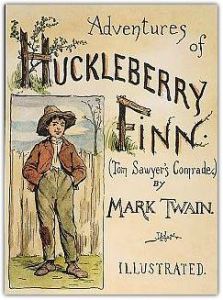
 As part of our home-school English curriculum this year, I decided to tackle Twain’s The Adventures of Huckleberry Finn.
I’ve read a few of the for and against arguments on the internet, by writers who either have a higher opinion of themselves (than they do of Twain); or they raise Twain to a higher level, just because he’s Twain.
My conclusion is this: forget all the, “I’m offended, therefore, ban ‘The Adventures of Huckleberry Finn’ because Mark Twain uses offensive language.” Ditch the flip side, which says, “I’m offended because you’re offended that Mark Twain didn’t consider your feelings before he wrote the book”.
What should be deemed offensive is the fact we’re told our children cannot be taught to discern for themselves – told they cannot learn the difference between appropriate and inappropriate language.
Especially the term Mark Twain contextually applies to Huck’s African-American friend, Jim.
Such an ideological imposition goes against everything that my role as an educator involves.
Such as teaching kids how to think for themselves and act responsibly with what they’ve been taught.
I’m a facilitator, not a computer programmer.
I facilitate the learning process. I don’t insert information into an object in a certain way, in order to get a specific set of desired results on demand.
Although age, and capability, are factors for why filtering certain topics is essential to healthy nurturing, I don’t water down facts to appease feelings.
With these age, and capability factors in mind, I present the how, and we discuss the what.
Deep learning requires learning the hard stuff, and how to digest it. We read, learn, and act, does not equate to, “we install and stoically obey”.
Learning is a journey. It’s a discipline from which we grow together. This is encapsulated in the whole meaning of reader beware (caveat lector), and it corresponds perfectly with buyer (consumer) beware (caveat emptor).
For example: my students know the difference between Niger (the Latin adjective for black, pronounced Nigh-jer), and the perversion of the adjective used to refer to African-Americans in a derogatory way.
Our homeschoolers understand that the name of the country Nigeria is not pronounced nor used with that pejorative in mind.
They are capable of concluding whether or not a term has historical significance – whether or not that term was used in such a way to control or abuse others. If so, they can make an informed choice about whether that term should to be used because they understand the historical context.
Whitewashing history in order to make it digestible isn’t conducive to education proper.
Take for instance, the term ‘’wandering jew’’. This is a common name of a pervasive weed in Australia. It pops up everywhere and is hard to get rid of. But the term raises some important questions: a) is the name of the weed, “wandering jew”, a term of endearment, or is it a pejorative? b) Can the term be understood differently? Just because I think the phrase is potentially offensive doesn’t mean that a Jewish person would agree. c) The plant is strong, hardy, and persistent with okay flowers. Instead of disparaging Jewish people, does it stand as a compliment to them?
Instead of banning terms, we educate our children about them. We teach them that the term ‘wandering jew’ can be viewed as a slur on a people group, used in order to dehumanize them. We also take note of the possibility that ‘wandering jew’ could also be viewed as a term of endearment.
As a result, while knowing that the phrase is common, we give them reason whether or not to insert weed, where jew once stood or keep it. The consensus has been to use ‘wandering weed’ instead of ‘wandering jew. ’ If, however, someone used the term ‘wandering jew, our children would understand its reference, and if someone was offended by it, they could understand why.
We can teach this without demanding that all horticultural books or websites that use the term “wandering jew” be banned.
Just because some Jewish folks might be offended, that doesn’t mean we have to ban it. Better to understand the how and why instead and apply individual responsibility to when, where, and how the term is used.
Likewise, just because the African-American community might (and some do[i]) use the pejorative version of the word ‘Niger (Nigh-Jer)’, doesn’t justify our own use of it (no matter how hypocritical it may seem).
In the case of ‘The Adventures of Huckleberry Finn, the student is taught to understand what the word means, how and why it was once used, and to whom it was once applied.
Instead of having them repeat the word, the pejorative version of ‘niger (nigh-jer)’ is easily replaced by the reader with African-American. We acknowledge the complications but chose to think for ourselves instead of having a censor do that job for us.
The genius of ‘The Adventures of Huckleberry Finn is that, when allowed to speak for itself, Twain confronts us with the harsh reality of how words have been used to dehumanize others.
Twain isn’t toxic.
In order to holistically educate our students about the slave trade and the abuses carried out under the banner of racism, they have to be allowed to be confronted with the truth. The truth and the words associated with it. Thanks to Mark Twain, our students are no longer spectators. They get to participate in, and experience, hard truths through the eyes and ears of Twain’s characters.
There is no reason to ban The Adventures of Huckleberry Finn’. Any ban would teach students to steer around being confronted with the horror and tragedy of that era (especially white folks[ii]). It denies them empathy and understanding.
Calls to ban the book fail to recognise that the essential building blocks of effective reconciliation and responsible freedom is an education free of emotional bias and ideological interference.
Banning a book because of a word that it uses, is asinine and ignorant – the very basis of Hannah Arendt’s ‘’banality of evil’’; a phenomenon that leads to the mass tolerance and participation in totalitarianism by people who are blinded by an uncritical trust in the blind bureaucrats who lead them[iii]. Not only would a blanket ban on ‘The Adventures of Huckleberry Finn’ disallow children access to an experience of the past, such a blanket ban would have to be applied to many African-American rappers, and movies where the pejorative use of ‘niger (nigh-ger)’ is applied regularly; the quintessential example being, N.W.A.
When reading the text, Twain’s consistent use of the pejorative derivation of the Latin word for black, “niger (nigh-ger)”, is easy enough to switch with African-American. Children can clearly see that black slaves are the category to which such a pejorative has been applied.
Individual responsibility matters.
Why all calls for a ban on The Adventures of Huckleberry Finn ultimately fail is that they are based on fear. If we give in to this, we let the past determine the future; and set students up to repeat the past. Fear underlines racial hatred as much as excessive ethnic pride does. It restricts us from seeing our neighbour, and having our neighbour see us.
In addition, we shouldn’t fear words; we should continue the age-old quest of learning how, when, why, and where to apply and respond to them.
Parents and educators need to push back against any technological society that tries to program our kids as if they were computers.
Conveyor belt education as part of an industrialised education complex has been an attempt to produce a certain type of human, if not a certain type of voter. Androids are programmed; humans are not.
Yes, humans can be influenced by conditions, but humans can also learn to overcome those conditions. We adapt because the gift of reason, empowered by God’s grace, hope, faith, and love, allows us to overcome. We read, learn, and act; therefore, it does not equate to “we install and stoically obey”.
What is, and should be deemed offensive are attempts to tell us all what to think. The education industrial complex, for example, tells us it needs to create “safe spaces”. Sinless spheres are empty of any opportunity to develop reason, faith, and resilience.
The subliminal message is that today’s men and women can’t be trusted to process or understand the power of the words that encounter humanity on a daily basis; words that come to us as either comfort, confrontation, conviction, or a combination of the three.
In a nutshell, “experts” take the false view that humanity cannot be trusted with the God-given permission to speak freely; therefore, thought, conscience, and speech need to be controlled. The fact that actions cannot be justified by their consequences is ignored.
Free speech is vital to our humanity. We need it in order to exist, first, in order to be free for God, and second, to be free for others. We encode, decode, and then reciprocate responsibly. Without that freedom, we fail, as Karl Barth astutely put it, to see our neighbour and have our neighbour see us:
‘Humanity as encounter is looking each other in the eye […] Humanity as encounter must become the event of speech. And speech means comprehensively reciprocal expression and its reciprocal reception; its reciprocal address and its reciprocal reception. All these four elements are vital.’
(Karl Barth, The Basic Form of Humanity, CD 3:2:251)
Banning The Adventures of Huckleberry Finn denies humanity by exalting the inhumanity Twain’s adventure story ultimately and so brilliantly decries.
References:
[i] This is so pervasive; I don’t really see a need to highlight any specific examples. However, for the sake of thoroughness, see the movie New Jack City, a good portion of Ice Tea’s albums, and the rappers N.W.A. (the abbreviation goes without spelling it out).
[ii] If I was to unpack this further, I would say that, should the concept of “white privilege” actually exist, banning Twain’s book would only be feeding “white privilege”, not answering it, or having white people repent of it. If anything calls to ban the book, it proves that “white privilege” is a myth.
[iii] Karl Barth (CD.3:2:252) : “Bureaucracy is the encounter of the blind with those whom they treat as blind.”
[iv] Barth, K. 1960. CD. 3:2, The Doctrine of Creation, The Basic Form of Humanity. Hendrickson Publishers
*UPDATED to improve grammar & flow 2nd March 2024. RL
 Rod Lampard
One thought on “A Case Against Banning, Mark Twain’s, ‘The Adventures of Huckleberry Finn’”